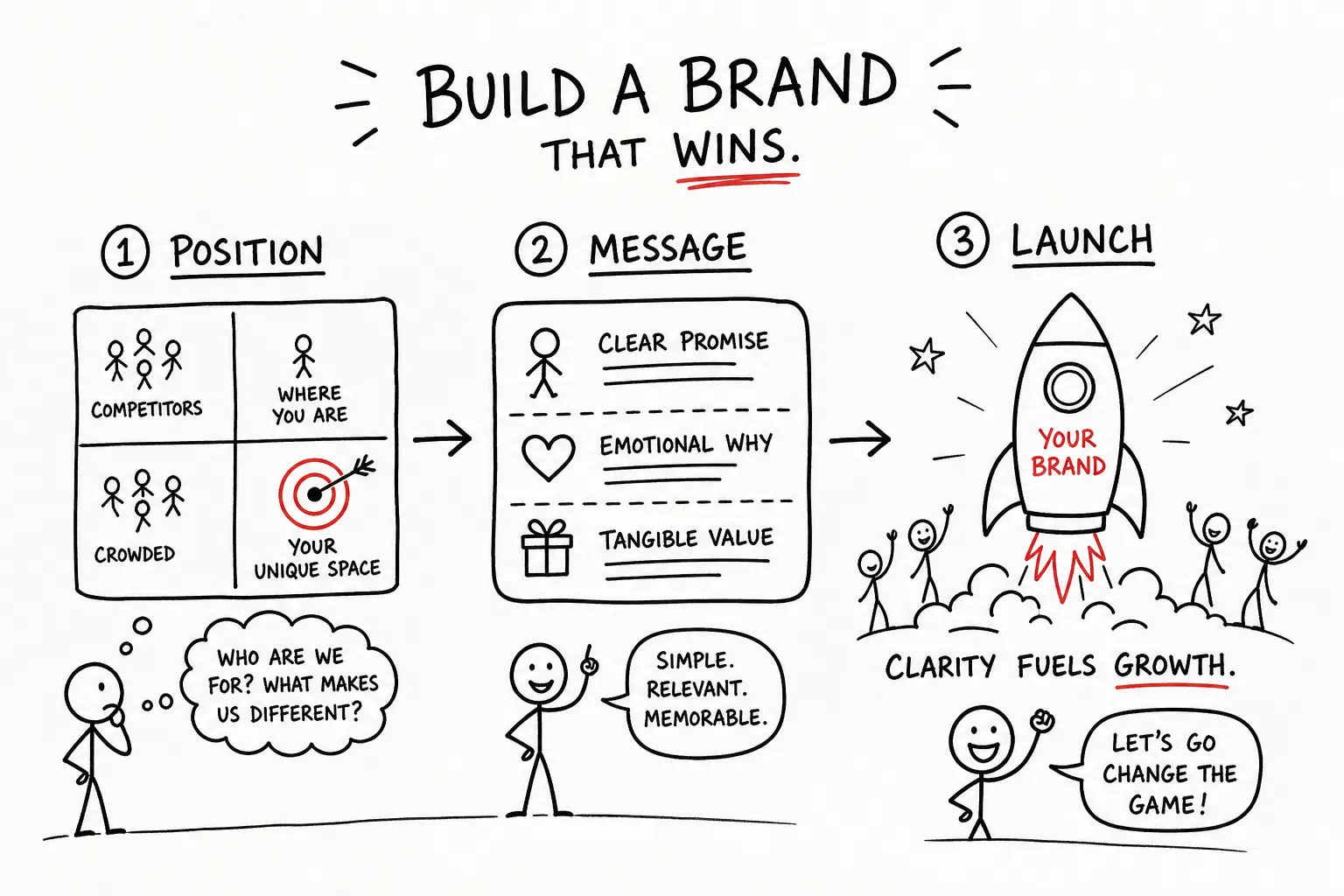

A clear brand strategy for startups isn’t a finishing touch; it’s the frame that makes your product legible to the people you’re trying to reach. Most founders treat branding as something to sort out after the product works and early customers are in the door. It’s a reasonable-sounding plan, and it’s one of the quieter reasons early-stage companies stall before they ever get that traction.
Unclear positioning doesn’t just make marketing harder. It creates friction in investor conversations, sales calls, and even internal decisions about what to build next. Without a clear brand strategy, marketing becomes noise: you’re broadcasting into a crowded room and hoping the right person turns around. Most won’t.
This article walks through the three foundational pillars of startup branding: positioning, messaging, and visual identity. Then it maps a realistic 90-day plan to get essential brand assets live, plus three KPIs that show whether any of it is working. This framework reflects the strategy-first approach used at Exult Creative Inc. when working with early-stage founders, built for real business problems, not assembled from marketing theory.
Why startups that skip brand strategy almost always stall
Somewhere along the way, “build it first, brand it later” became conventional wisdom in startups. The logic is understandable: don’t spend resources on positioning before you know what you’re positioning. The problem is that branding isn’t decoration you add on top of a working product. It’s the frame that makes the product legible to the people you’re trying to reach.
Without that frame, every marketing message conflicts with the next. Customers get confused before they ever buy. Investors hear a pitch and can’t accurately repeat it at their next partner meeting. The product might work perfectly. Nobody outside your team can clearly articulate what it’s for or who it’s for.
One widely cited CB Insights analysis found that marketing-related causes, including unclear positioning and ICP misalignment, sit behind anywhere from 42% to 69% of early startup failures. Most of those failures don’t announce themselves as brand problems. They look like stalled pipelines, flat conversion rates, and investor meetings that go nowhere. A founder who can name exactly who they serve, what problem they solve, and why they win creates a more fundable narrative than one who says “we serve everyone.” Investors skim. Clarity makes a startup easier to understand and easier to champion in a room you’re not in.
Brand strategy for startups: the three pillars
Brand strategy sounds abstract until you break it into its actual components. For an early-stage startup, it comes down to three things: positioning, messaging, and visual identity. None of them works well without the other two.
Positioning: brand positioning for startups starts with one question
Positioning answers one question: why should your exact customer choose you over every alternative, including doing nothing? Consider how some of the clearest startup brands have handled this. Airbnb positioned itself as a marketplace for booking rooms with locals rather than hotels, for travellers who wanted a more home-like stay. Mercury positioned itself as a banking platform built specifically for high-growth startups. Figma is positioned around real-time collaborative design, directly displacing desktop tools that couldn’t do that. Each statement names a market, a customer, and a differentiation. None of them hedged.
For additional real-world references, see the brand positioning strategy examples and the seven examples of strong brand positioning that show how specificity drives clarity in market narratives.
Sharp positioning does two things simultaneously: it attracts the right people and repels the wrong ones. That second part is what makes founders nervous, but it’s exactly what makes the strategy work. A B2B SaaS company that says it serves “teams of any size” will consistently lose to one that says it serves “ops teams at 50-to-200-person companies.” Specificity isn’t exclusion; it’s a signal.
Messaging: brand messaging for startups turns positioning into words people feel
Messaging is positioning made human. It’s the headline on your landing page, the second sentence in your pitch, the subject line of your first cold email. The brand strategy lays the foundation; messaging is what customers actually hear and remember. If your positioning is strong but your messaging is vague, the strategy isn’t reaching anyone.
Visual identity: the face of your strategy, not a standalone exercise
Logo, color, typography. These aren’t arbitrary aesthetic choices, and they’re not separate from the strategy. A fintech brand targeting enterprise clients feels different from one targeting freelancers, and that difference has to show up visually. A strong brand identity for startups is cohesive with the positioning; a misaligned visual identity quietly undermines even strong messaging. Customers absorb signals from how something looks before they read a single word.
How to write a one-page brand strategy for startups
The most useful brand strategy document for a startup isn’t a 40-page deck. It’s one page. A founder who can fill it in clearly has already done most of the strategic thinking.
The positioning statement formula that actually works
The classic template: “For [target customer] who [need or problem], [brand name] is the [category] that [key benefit], unlike [alternative].” It sounds simple because it is. But filling it in without vague language is harder than it looks. Try completing it right now for your own startup. If you find yourself writing “businesses of all sizes” or “anyone who wants to save time,” the positioning work isn’t done yet.
Mercury works because it names a specific customer, a specific context, and a specific differentiator: banking built for high-growth startups, not the general public. There’s no room for ambiguity, which is exactly the point.
Building the one-page brand brief around that statement
Beyond the positioning statement, a startup brand strategy template typically includes a core audience definition, three to five brand values, one brand voice descriptor, and a primary CTA. Think of it as a recommended structure rather than a rigid requirement; the goal is a single document that becomes the reference point for everything built afterward: website copy, pitch decks, social profiles, sales scripts. Most founding teams can draft it seriously in a few focused hours, and doing so saves weeks of confusion during execution. If your team debates what the brand should say every time someone writes a new piece of copy, you don’t have a brief yet.
The clarity test: Can someone else pitch your brand from this page?
The brief works when a stranger can read it and accurately describe what your brand does, who it’s for, and how it sounds. If they can’t, the strategy isn’t clear enough. Run this test before you spend a dollar on design or advertising.
Messaging that connects with the right buyers
Not all messaging works the same way across markets. How you write for a B2B SaaS buyer is structurally different from how you write for a B2C consumer, and conflating the two is one of the most common early messaging mistakes.
Why B2B SaaS messaging and B2C messaging need different approaches
B2B SaaS converts better when messaging is problem-forward, proof-backed, and outcome-specific. Buyers are evaluating ROI, efficiency, and risk across a longer decision cycle. A strong B2B headline focuses on a clear business result, something like “Reduce reporting time from days to hours.” A strong subhead then names who it’s for and what problem disappears. B2C works differently: lead with desire or a relatable aspiration, make the benefit feel personal, and keep the path to action frictionless. “Feel organized every day” speaks to how the customer wants to feel, not what the software technically does. That distinction drives the conversion, not the feature list.
For teams building B2B positioning and needing a practical framework to turn strategy into go-to-market copy, the B2B SaaS positioning canvas is a useful tool to structure your messaging around customer outcomes and proof points.
The go-to-market messaging stack: what to write first
Founders often try to write every piece of copy at once and end up with nothing that’s actually sharp. The go-to-market brand strategy for your messaging stack requires only three things upfront: a homepage headline that states the value proposition clearly, a one-line company descriptor for profiles and bios, and an elevator pitch for sales and investor conversations. Get these three right first. Everything else, email sequences, blog content, ad copy, gets refined once these are settled and tested against real responses from real people.
Your 90-day startup brand playbook
Most startup brand timelines are either too slow (months of internal debate before anything ships) or too fast (a logo and a landing page built in a weekend with no strategy underneath). Ninety days give you enough time to do it right without letting it become a distraction from building.
Days 1 to 30: lock the strategy before touching design
This month is entirely about clarity. Write the positioning statement. Draft the one-page brand brief. Define the core audience with real specificity. Nail the three-part messaging stack. Nothing visual yet. A startup doesn’t need a full brand system to launch; it needs a clear foundation. Get that foundation documented before anyone opens a design tool.
Days 31 to 60: build the minimum viable brand assets
With strategy locked, move to execution. The essential assets are a visual foundation (a logo, two brand colors, one typeface), a landing page with the core value proposition and an email capture, and basic brand voice guidelines. A visual foundation takes roughly one to five days to produce. A landing page takes one to seven days, depending on complexity. These aren’t large investments of time; they’re focused ones. The goal isn’t a complete brand system; it’s a coherent, credible presence that reflects the strategy you built in month one.
Days 61 to 90: launch, listen, and adjust
While the first two phases were about building, this one is about learning. Put the brand live. Set up the email capture. Publish a first piece of content. The point of this phase isn’t perfection; it’s exposure. Real feedback from real people sharpens what was built in the first 60 days faster than any internal review ever will. You’ll learn far more from real visitors to a live landing page than from multiple rounds of internal revision on a draft.
Three signals that tell you whether your brand is working
Brand impact doesn’t show up cleanly in a single dashboard metric. But there are three signals worth tracking from month one that together tell a reliable story about whether the strategy is landing.
For practical advice on selecting and tracking the right startup KPIs, see this guide on identifying and measuring startup key performance indicators, which explains how to prioritize metrics that reflect brand and growth health.
Website traffic and direct search as awareness proxies
Growing organic traffic and branded search volume are the first signs that startup branding is reaching the right people. If more people are finding the site and some are specifically searching the company name, awareness is building. Flat branded search in the first 90 days isn’t necessarily a failure; it’s a signal that distribution needs attention or the positioning hasn’t been stated loudly enough in enough places yet.
Inbound lead quality as a messaging signal
Vague messaging attracts vague inquiries. Sharp messaging attracts buyers who already understand the offer and are closer to a decision. If the leads coming in don’t match the intended customer profile, the messaging needs recalibration, not the channel. Before changing platforms or ad spend, look at what the brand is actually promising and whether it’s specific enough to filter the wrong people out.
Customer acquisition cost as the long-term brand health metric
CAC doesn’t move quickly, but tracking it from month one creates a baseline. A brand strategy that resonates makes it cheaper to win new customers over time, because the market begins to recognize and seek out the brand rather than needing to be convinced from scratch on every interaction. This is the KPI that proves the brand is doing economic work, not just aesthetic work. If CAC is declining as brand awareness grows, the strategy is working. If it isn’t, something in the positioning or messaging chain has a gap worth finding.
Being clear before being loud
Startup branding isn’t about having the most polished logo or the cleverest tagline. It’s about being clear before you’re loud. Positioning, messaging, and visual identity are the three things that make every other marketing effort more efficient, every pitch more convincing, and every customer conversation more focused.
This is the work Exult Creative Inc. does with early-stage founders: strategy first, execution second. The one-page brief, the positioning statement, the 90-day roadmap: these aren’t just frameworks. They’re the difference between a brand that drifts and one that compounds.
Before you scale, ask yourself one honest question: do you have a clear brand strategy for startups that will grow with your product, or are you still planning to figure out the brand later?