
Many founders treat branding as a design problem. Pick a logo, choose some colors, ship the site, it feels productive, it feels like progress, but it’s the exact sequence that produces startups nobody remembers. This startup branding guide exists to break that pattern: to show founders why strategy has to come before design, and how to build a brand that actually works.
Branding isn’t aesthetics. It’s the system that tells the right people why your startup exists and why it’s the right choice for them. At Exult Creative Inc., we often see founders arrive mid-project with a polished logo, a color palette they love, and no positioning, no voice, and no message that means anything to their target customer. The design looks fine. The brand does nothing.
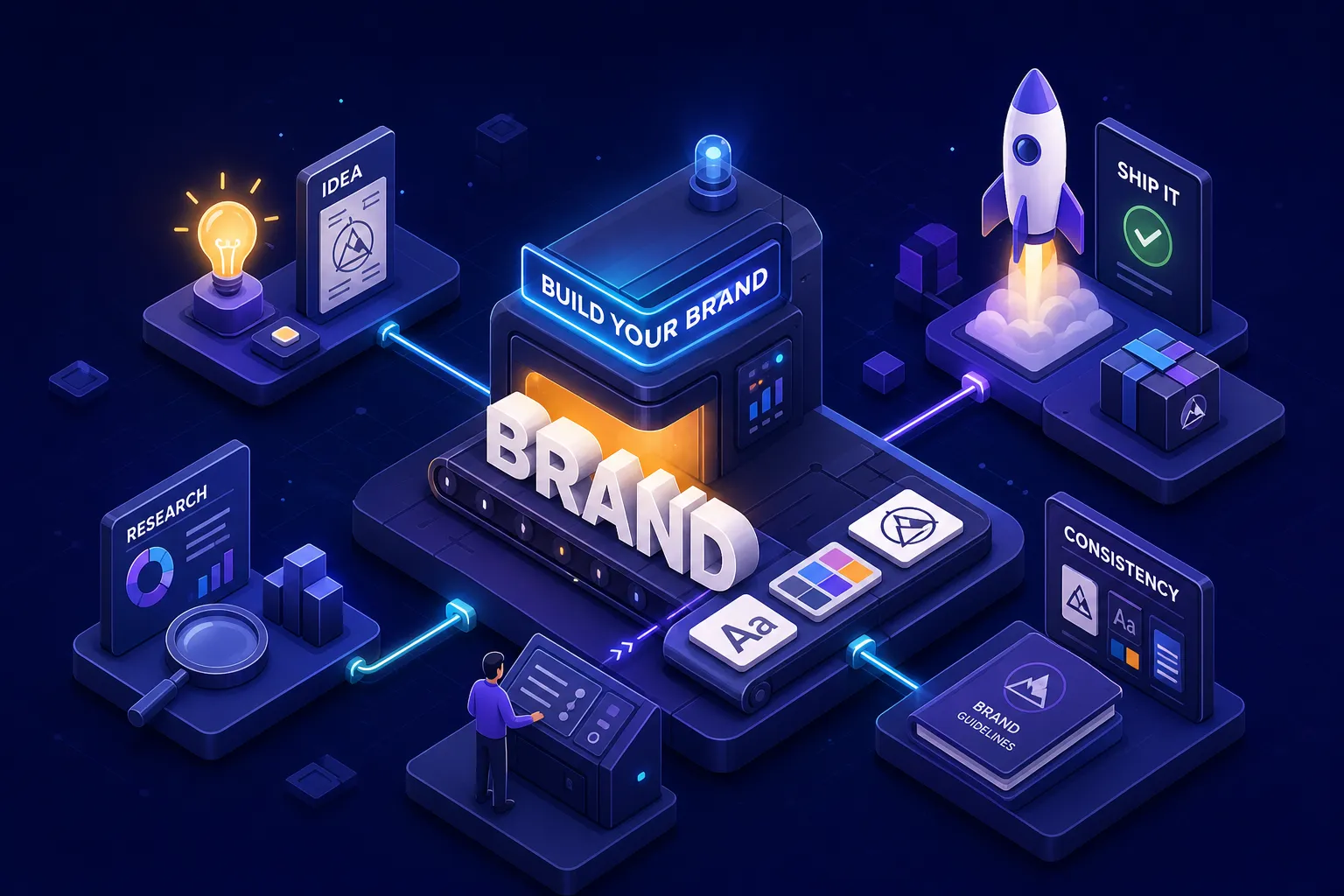
What follows is the process we use to fix that, from positioning to a one-page brand guideline, with honest timelines and budget options for where you actually are in your startup journey.
Your Logo Isn’t Your Brand (and Confusing the Two Is Expensive)
The logo is an output. Brand strategy is the input. When founders skip strategy and jump straight to design, they end up with visuals that feel disconnected from the actual business. The gap surfaces during fundraising or early customer acquisition, lower conversion rates, weaker differentiation, and messaging nobody can articulate.
What Brand Strategy Actually Includes at the Startup Stage
Brand strategy is not a values poster or a mood board. At the startup stage, it covers audience definition, competitive positioning, brand personality, core promise, and messaging pillars. Every piece of design and copy has to be built on that foundation. Without it, design decisions are guesswork dressed up as taste.
The Real Cost of Skipping Strategy
Consider a scenario we encounter regularly: a founder spends $3,000 on a logo and $5,000 on a website, then realizes their messaging attracts the wrong audience or fails to differentiate from three direct competitors. Presented here as a composite illustration, it reflects a pattern where rework costs more than the original strategy would have. More damaging than the money is the time. Rebuilding brand positioning six months after launch, while trying to grow, is genuinely hard.
Why the Best-Looking Startups Still Feel Forgettable
A startup can have beautiful design and still communicate nothing distinctive. Visual polish and brand coherence are not the same thing, clarity and differentiation are strategic decisions made well before any designer opens a file. No amount of kerning fixes a positioning problem.
Startup Branding Guide: Define Your Audience and Positioning First
Without a clear answer to who the brand is for and what it uniquely offers, every downstream decision floats. Visual style, tone, naming, messaging, all of it remains unanchored until positioning gives it direction.
Getting Honest About Who You’re Actually Building For
Demographics matter less than psychographics, pain points, and the specific moment someone turns to a product like yours. The sharper the audience definition, the stronger the eventual brand. If your target customer is “businesses that need better software,” that’s not a target, that’s a census category. Vague audiences produce vague brands, and vague brands don’t convert.
Mapping Your Competitive Position
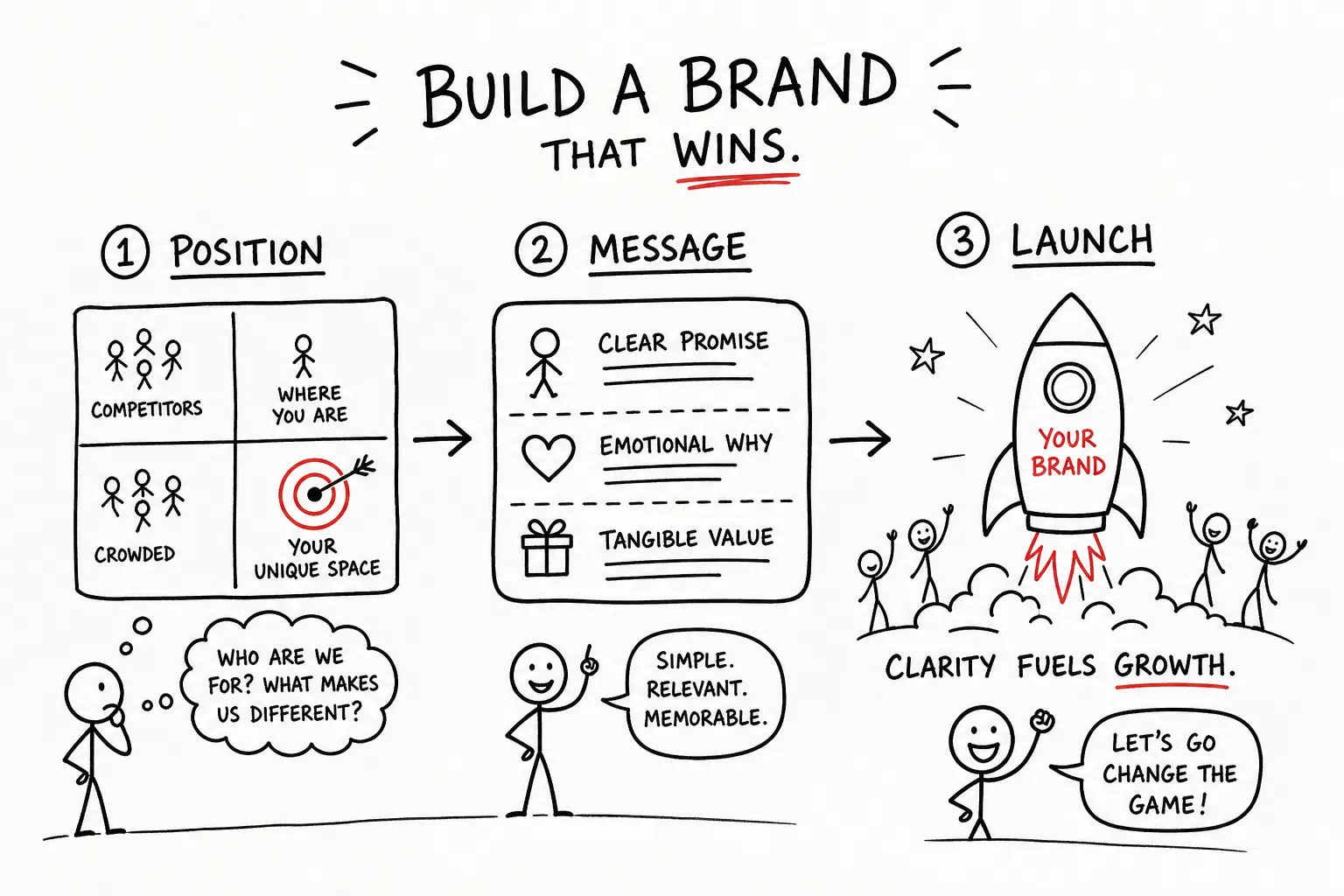
Run a competitive audit: identify four to six direct and indirect competitors, analyze their visual and verbal positioning, and find the open territory. The goal is not to copy what works but to identify what’s missing. Brand positioning lives in the gap, not in the center of what everyone else is already saying.
The One-Sentence Positioning Statement Every Startup Needs
A workable positioning statement follows a simple structure: who it’s for, what it does, why it’s different, and what the proof is. For example: “For [audience], [Brand] is the [category] that [key benefit] because [proof point].” That sentence becomes the filter for every brand decision that follows. If a design choice, a headline, or a product feature doesn’t support it, it’s worth questioning. Write it until it’s specific enough to be useful and honest enough to believe. If you want a practical template, see how to write a positioning statement for your startup.
Building a Verbal Identity That Actually Sounds Like Something
Most startup branding processes jump from positioning straight to logos. Messaging and voice get a paragraph, if that. This is a mistake. Words are what customers read, hear, and remember, a visual identity without a verbal identity is a face with no voice.
Finding Your Brand Voice (and Making It Consistent)
Brand voice is not just “friendly” or “professional.” Those words describe half the companies on the internet. A useful voice definition picks three to four specific tonal traits, defines what each means in practice, and pairs each with examples of on-brand versus off-brand language. “Direct but never blunt. Confident but never arrogant.” That’s a voice you can actually write from.
Writing a Messaging Framework for Your Core Audiences
A messaging framework organizes the key claims your startup makes, who they’re aimed at, and the evidence behind them. Structure it around a headline message, two or three supporting pillars, and proof points for each. This framework feeds everything: website copy, pitch decks, sales conversations, onboarding emails. Build it once and reuse it constantly. Think of it as a brand strategy checklist you can run every time new content goes out the door.
Naming and Tagline: How Much They Matter (and When to Revisit Them)
A great name helps. A mediocre name doesn’t kill a startup. What tends to matter more in practice is a tagline that makes your value immediately clear to a first-time visitor, specific, memorable, and distinct from the category default. The test is simple: swap your tagline with a competitor’s and see if anyone notices the difference. If they don’t, rewrite it.
Startup Branding Guide: Designing a Visual Identity System That Holds Up
Once strategy and messaging are locked, visual design has a real brief to work from. This is where the logo, color palette, and typography actually belong in the process, not before, but now.
Logo, Color Palette, and Typography: What to Get Right First
The essential assets are a primary logo with clear space rules, a limited color palette of three to five colors (one primary, one secondary or accent, one to two neutrals), and a two-font typography system pairing one expressive headline font with one clean body font. Restraint is the strategy. Fewer choices applied consistently outperform a large system applied inconsistently, every time. If you need inspiration for pairing typefaces, Figma’s font pairings resource is a helpful starting point.
Building a Brand Kit Template That Grows With You
A functional brand kit template at the startup stage includes logo files in multiple formats, color codes in HEX, RGB, and CMYK, font access notes, and social and presentation templates. It doesn’t need to be elaborate, it needs to be usable by anyone on the team without asking the founder. If the team has to guess, the guidelines aren’t guidelines. They’re decoration.
Visual Mistakes That Are Easy to Avoid With a Little Planning
The most common pitfalls are using too many colors, choosing fonts that don’t render well on screen, not testing the logo at small sizes, and building an identity that mimics a competitor’s visual language so closely it disappears into the category. A relatively small amount of upfront planning catches all of these, none of them require a bigger design budget, just a more strategic one.
Assembling Your One-Page Startup Brand Guidelines
Brand guidelines don’t need to be a 50-page PDF. For most startups at the early stage, a focused short guide, typically one to six pages depending on complexity, covers everything the team and vendors need to apply the brand correctly. The goal is consistency, not completeness.
What to Include and What to Leave Out
The minimum viable startup brand playbook covers: brand story in two sentences, logo usage rules with do/don’t examples, color palette with codes, typography hierarchy, tone of voice summary, and one page of correct application examples. Everything else can wait until the brand is more established. Ship the guideline when it’s useful, not when it’s perfect. For a practical checklist to help you create a concise guide, see how to create a brand style guide.
DIY Tools vs. Working With an Agency
Tools like Notion, Figma, and Canva make it possible to document a brand without a designer, and that works, up to a point. If the brand foundation (positioning, messaging, visual system) hasn’t been built with strategic discipline, the guidelines just document confusion. Working with a strategy-led agency like Exult Creative Inc. means the system and its documentation are built simultaneously, so founders launch with a brand that’s coherent from day one: positioning, voice, visual identity, and guidelines delivered as one integrated output rather than four disconnected pieces.
Launch Timeline, Budget Reality, and Measuring Early Brand Success
Founders need a realistic picture of how long this takes and what it costs, and how to tell, after launch, whether the brand is doing anything at all.
Realistic Timelines and Budgets for Pre-Seed and Seed Startups
A DIY brand build at pre-seed takes two to six weeks and costs roughly $0 to $5k using tools and founder time. An agency-led engagement at the same stage runs four to ten weeks and typically costs $10k to $50k or more depending on scope. At seed, timelines extend and budgets grow accordingly, because the brand needs to support scale, not just viability. Match the investment to the milestone: pre-seed needs investor-ready positioning; seed needs a system built for growth.
How to Know If Your Brand Is Actually Working
Early brand metrics don’t require a full analytics stack. Pick three to four signals and track them consistently: branded search volume, direct traffic, conversion rate by channel, and NPS as a downstream sentiment signal. A short brand recall survey run quarterly, either unaided (“name a company that does X”) or aided (“have you heard of us?”), helps track whether awareness is building. The point isn’t precision; it’s having a baseline so brand investment can be evaluated, not just assumed.
Clarity Is a Commitment, Not a Sprint
Brand-building is not something you do before launch and then file away. It’s an ongoing commitment to saying the same true thing, in the same clear way, across every place your startup shows up. The startups that build brands that last aren’t necessarily the ones with the biggest budgets or the flashiest logos; they’re the ones that took the time to understand who they were for and said it consistently.
The founders who get this right share a common habit: they treat positioning as the foundation, not the afterthought. They define the audience, anchor the messaging, build a visual system that holds together, and document it simply enough that anyone on the team can use it. Use this startup branding guide to work through each of those steps in order, and if you’d rather move faster with fewer wrong turns, Exult Creative Inc. does exactly this work for early-stage companies every day. The one path that doesn’t work is skipping the strategy and hoping the design carries it.